Beyond the ordinary
Li
Beyond The Ordinary
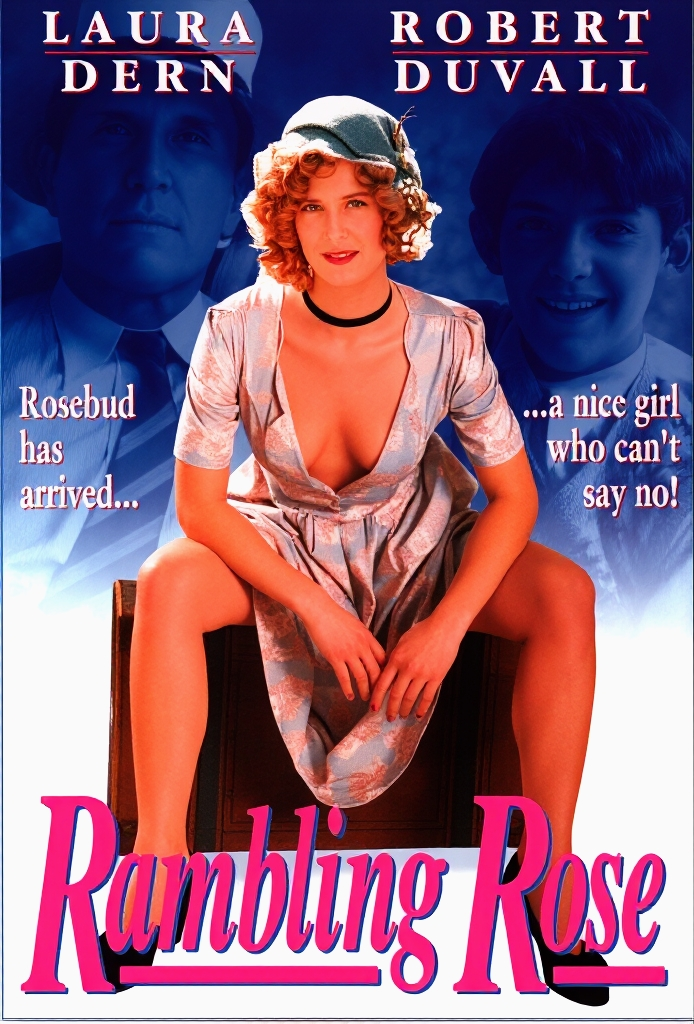
Rambling Rose is a 1991 American drama set in Georgia during the Great Depression. Directed by Martha Coolidge, it is based on the 1972 novel by Calder Willingham. The story follows Rose (Laura Dern), a young woman with a troubled past who is taken in as a domestic servant by the Hillyer family. Her presence creates both charm and disruption as she navigates her intense need for love and her overt sexuality, which impacts every member of the household.
Plot Summary
• Arrival: Rose arrives at the Hillyer home in 1935, seeking to escape a life of prostitution.
• Conflict: She develops romantic feelings for the father, Mr. Hillyer (Robert Duvall), who rebuffs her, while the 13-year-old son, Buddy (Lukas Haas), experiences his sexual awakening through her.
• Family Dynamics: Mrs. Hillyer (Diane Ladd) becomes Rose’s protector, notably defending her against a doctor's recommendation for a hysterectomy meant to "cure" her promiscuity.
• Legacy: The film is framed as a memory from an adult Buddy (John Heard), who reflects on Rose's indelible impact on his family.
Notable Cast & Characters
• Laura Dern as Rose: A "damaged" but good-hearted woman whose "rambling ways" stir the town.
• Robert Duvall as Mr. Hillyer: The bedrock Southern patriarch struggling with Rose’s presence.
• Diane Ladd as Mrs. Hillyer: An independent-minded woman who sees the best in Rose.
• Lukas Haas as Buddy: The young boy who falls in love with Rose.
Critical Reception & Awards
The film received high praise, currently holding a 100% approval rating on Rotten Tomatoes based on 20 reviews. Critics like Roger Ebert highlighted the ensemble's "best performances of the year".
• Academy Award Nominations: Laura Dern (Best Actress) and Diane Ladd (Best Supporting Actress) made history as the first mother-daughter duo nominated for the same film.
• Independent Spirit Awards: Won for Best Feature, Best Director (Coolidge), and Best Supporting Female (Ladd).
• Montreal World Film Festival: Laura Dern won Best Actress.
💡 Key Takeaway: The movie is often noted for its frank and sensitive exploration of female sexuality and the societal pressures of the 1930s South.
Humbert Humbert's Girlfriend
In the 1991 film Rambling Rose, the character Rose (played by Laura Dern) is not depicted as a paedophile in the clinical or predatory sense, but her actions involve a sexual encounter with a 13-year-old boy that modern audiences often view as statutory rape.
🔹️ The film, set in the 1930s, portrays
Rose as a vulnerable and simple 19-year-old woman with a history of trauma and sexual abuse. Her behaviour is framed by the narrative as a desperate, misguided search for love rather than a calculated predatory preference for children.
Context of the Relationship.
🔹️ The Character:
▪️ Rose is described as an overgrown
child who is mentally and emotionally stunted due to past abuse.
🔹️ The Scene:
▪️ Early in the film, Rose climbs into bed
with 13-year-old Buddy (Lukas Haas) for comfort. This leads to a sexual encounter where she allows him to touch her and she reaches a climax.
🔹️ Intent vs. Action:
▪️ The film's director, Martha Coolidge,
described the scene as being about "higher love" and a "sexual initiation" for the boy, though she acknowledged it is uncomfortable for viewers.
🔹️ Reactions:
▪️ Within the story, Rose immediately
feels guilty and begs Buddy not to tell his family, knowing the act was wrong.
Interpretations and Controversy.
🔹️ Nymphomania Diagnosis:
▪️ In the film, a doctor suggests Rose
has nymphomania (an outdated term for hypersexuality) and recommends a hysterectomy to cure her.
🔹️ Modern Criticism:
▪️ Many viewers and critics find the scene 'vile' [evil? (or evol)] or 'disturbing' arguing that it romanticises the sexual exploitation of a minor.
🔹️ Censorship:
▪️ The British Board of Film
Classification (BBFC) trimmed 20 seconds from the scene in 1991 because the actor playing Buddy was under 16.