A 'Chess'-Board?

The above is the front cover of a notebook.
The King's Tour
𝗗↙️𝗕🔃⬆️𝗡➡️𝗗𝗗🔃⬅️𝗡[⊗↙️𝗕⬆️𝗡]⬇️𝗕🔃 ↙️𝗝⬆️𝗠[⊗⬇️𝗖𝗵↖️𝗠][⊗↖️𝗚⬇️𝗠] ⬆️𝗚🔃[⊗↗️𝗡🔃]
The above is called The King's Tour because in generating the letters of NAME?, you move like a king on a chess-board - one square at a time in any direction.
🔹️ Using the above, starting at D,
you move from one letter to another following the instructions given. 🔃 means that you rotate - or flip in a + mirror - the current letter. ⊗ means Or and it allows you to select an alternative letter from the one preceding. Carrying out the task allows you to both operate the object and determine what it is.
🔹️ In performing the above task, you
will be in a similar position to the character in the RUSH song[👁 2112] who finds a musical instrument and achieves some level of learning what it is by operating it.
👁 RUSH - III: Discovery (2112) 🅼
🔹️ Note that there is the sound
of running water at the beginning of 𝗜𝗜𝗜.𝗗𝗶𝘀𝗰𝗼𝘃𝗲𝗿𝘆. This could be sound associated with a waterfall - such as the one in the video 𝗣𝗮𝗿𝗮𝗱𝗶𝘀𝗲 [👁 Feva]. I like to think that the intro to Discovery really is the sound of 𝗛𝗶𝗴𝗵 𝗙𝗼𝗿𝗰𝗲.
🔹️ So, what is this object?
▪️ It's a push-button or (touch-screen)
CALCULATOr.
🔹️ Using the two letters R and O
that resemble arabic digits, we can call the device 𝗖𝗔𝗟𝗖𝗨𝗟𝗔𝗧𝗢𝗥 𝟮𝟬 aka 𝗖𝗔𝗟𝗖𝗨𝗟𝗔𝗧𝗢𝗥⑳ or, simply, (The) 𝗖⑳. Taking C as 100 (URN), we have 100 + 20 = 120 = 360 ÷ 3 = GRO/6.
🔹️ A calculator is typically a
portable electronic device used to perform calculations, ranging from basic arithmetic to complex mathematics.
🔹️ Basic calculator models often use a 7-
segment system for displaying digits 1 to 9 as parts of a figure 8 shaped grid.
🔹 In Korean, HANGUL means
𝗚𝗿𝗲𝗮𝘁 𝗪𝗿𝗶𝘁𝗶𝗻𝗴. In my philosophy, truly great writing is a combination of the qualitative and the quantitative. The qualitative is things like prose, poetry, music, visual art and so on. The quantitative is, of course, all things mathematical. My personal system of writing is something I often call 𝗣𝗮𝘁𝗵𝗲𝗺𝗮𝘁𝗶𝗰𝘀 - or 𝗣𝗮𝘁𝗵 for short. Path can also be called 𝗛𝗮𝗻𝗚𝘂𝗹 and as such, it is everything involved in getting great writing on record.
🔻 More on CALCULATOR 20.
🔹️ Let G = 7 [the singular
(represented by a single digit) number of Christ], N = L = 50 [using roman numerals (URN)], C = 100 (URN) and R = 2. Then, G+N+L+R = 159.
🔹️ Also, N+D = 150 = 75 × 2. G+R =
9 [the singular (represented by a single digit) number of God].
🔹️ GRO [using
(my/)pathematical gematriaⒻ (UPG)] = 7⊕2⊕0 = 720 = 360×2.
𝗧𝘁 𝗤𝘂𝗶𝗿𝗸𝗶𝗻𝗴 𝗔𝗻𝗱 𝗢𝘁𝗵𝗲𝗿 𝗧𝗵𝗶𝗻𝗴𝘀.
🔹️ With this calculator, t is
slightly problematic. CH works well when you think of it's right hand-side but you have to accept an extra (mirrored) t on the left. This t is a pair of siamese twins - and can be considered a monster 🙂. When it comes to the second choice, J, we also have an extra t that is more capital (more like T) with one T overlaid on the other. This J t is like a CH t with it's head cut off. 🙂
🔹️ I like to call CH 𝗠𝗮𝗻𝗱𝗿𝗮𝗸𝗲 and
J 𝗗𝗲𝗰𝗮𝗽𝗶𝘁𝗮𝘁𝗲𝗱 𝗠𝗮𝗻𝗱𝗿𝗮𝗸𝗲.
🔹️ On a seven segment display unit,
the letter t looks like an angular lowercase c with an attached antenna 🙂. [👀🅲06👉]
🔹️ Is there a precedent for using 7 as
T or t?
👁 TOOL - 7empest 🅼
Beyond the ordinary
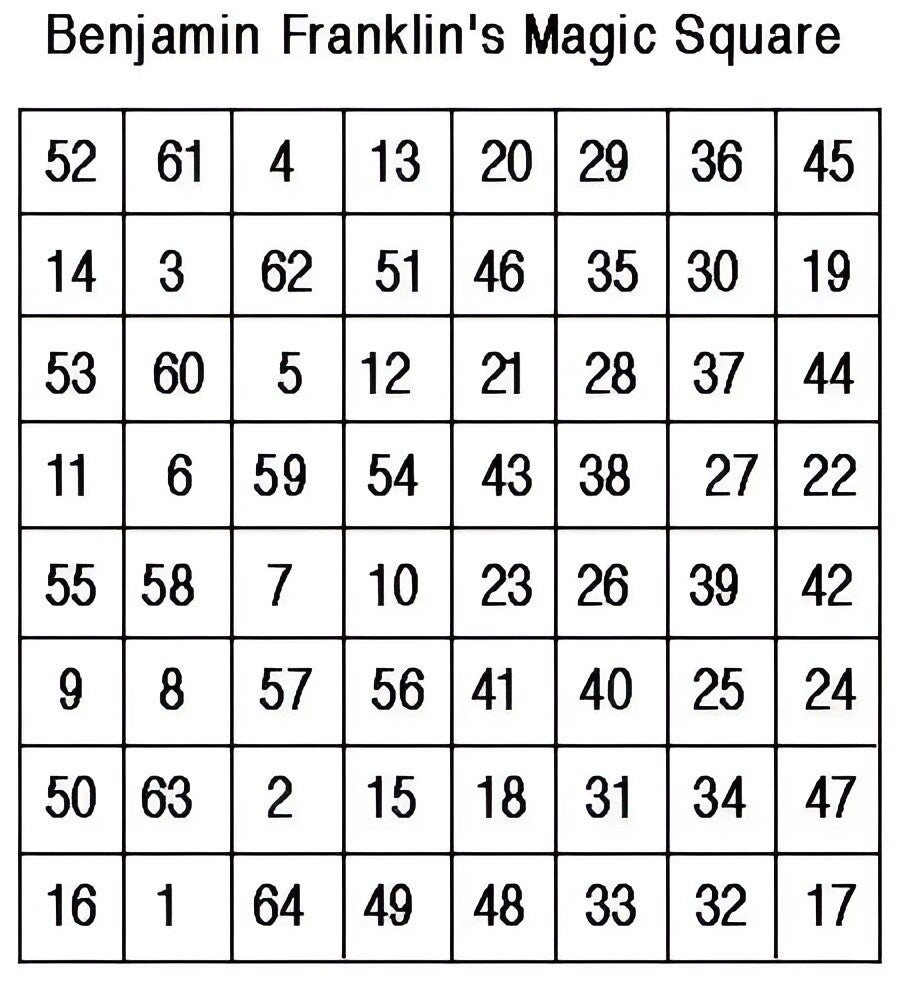
Every Row And Column Adds 2...The Overall Complexity Of Qu.
Beyond the ordinary
William H. Richardson & Ben Franklin
Franklin's Magic Squares
Benjamin Franklin constructed famous
8 X 8
and
16 X 16
"magic squares" (often called semi-magic squares) around 1750 and 1769, notably boasting sums of 260 and 2056, respectively. These squares feature incredible, complex properties beyond standard magic squares, including "bent" diagonal sums, half-row/column totals, and
4 X 4
sub-square sums that all match the main total.
Wolfram MathWorld
Key Properties of Franklin's
8 X 8
Magic Square:
Constant Sum: Each row and column totals 260.
Bent Diagonals: Any diagonal segment (4 cells) wrapped around the grid totals 260 (👁 image ).
Half-Rows/Columns: Each half-row or half-column totals 130.
Corners & Center: The four corners plus the four middle squares equal 260.
Key Properties of Franklin's
16 X 16
'Magickest' Square:
Constant Sum: All 16 rows and 16 columns sum to 2056.
Sub-Squares: Every
4 X 4
sub-square within the
16 X 16
grid sums to 2056.