
Our Mistory
With this page, I mostly explore the Pathematical significance of №12.

Our Mistory
The Pilgrim's Progress
is a famous 1678 Christian allegory written by John Bunyan. Often cited as the second most-read book in history after the Bible, it tells the story of a man named Christian and his harrowing journey from the City of Destruction to the Celestial City (Heaven).
Σ (№12) Information
From The Bible.
Jesus specifically chose 12 apostles (often called "the Twelve") to accompany him during his ministry, according to Matthew 10:2–4 and Mark 3:14-19. Following Judas Iscariot's death, Matthias was chosen to replace him in Acts 1. Others, including Paul, are also designated as apostles in the New Testament.
Key Details About the Apostles:
The Original 12: Peter, Andrew, James (son of Zebedee), John, Philip, Bartholomew, Thomas, Matthew, James (son of Alphaeus), Thaddaeus (Jude), Simon the Zealot, and Judas Iscariot.
Replacements and Additions: Matthias was chosen to replace Judas Iscariot.
Paul the Apostle: Known as the "Apostle to the Gentiles," Paul was appointed directly by Jesus after the resurrection.
Definition: "Apostle" means someone sent out with a specific purpose (as opposed to a disciple, which is a follower). While the core group was 12, the term is used broadly for others, such as Barnabas, in the book of Acts.
Beyond The Ordinary
The Traditional 12 Days Of Christmas
The Traditional 12 Days Of Christmas, or Christmastide, start on Christmas Day (Dec. 25) and end with Twelfth Night (Jan. 5), representing the time between Jesus's birth and the Magi's visit. These days were historically celebrated with feasts for saints, gift-giving, and festive games, particularly in Tudor England.
The 12 Days Calendar.
🔹️ Dec 25: Christmas Day (Feast of
the Nativity).
🔹️ Dec 26: St. Stephen’s Day (second
day of Christmas).
🔹️ Dec 27: Feast of St. John the
Apostle.
🔹️ Dec 28: Childermas (Holy
Innocents).
🔹️ Dec 29: St. Thomas Becket.
🔹️ Dec 30: Holy Family.
🔹️ Dec 31: New Year’s Eve (St.
Sylvester's Day).
🔹️ Jan 1: New Year’s Day (Feast of
the Circumcision/Mary Mother of
God).
🔹️ Jan 2: St. Basil the Great.
🔹️ Jan 3: Feast of the Holy Name.
🔹️ Jan 4: St. Elizabeth Ann Seton.
🔹️ Jan 5: Twelfth Night (Epiphany
Eve).
Traditional Traditions.
Twelfth Night Party:
The final night, Jan 5, was traditionally celebrated with a large party, games, and a cake containing a hidden bean and pea to select a king and queen.
Feast Days:
Each day commemorates a saint, such as St. Stephen (26th) or St. John (27th), sometimes involving the blessing of, for example, wine or horses.
Giving Traditions:
While the famous song lists gifts, the traditional season historically focused on feast days and, in some traditions, New Year's Day as a time for gift-giving.
The Carol And Symbolism.
The famous carol, first printed in 1780, likely served as a memory game. While sometimes interpreted as a coded, secret catechism for Catholics, historians often see it as a, perhaps, fun, folkloric, or purely festive song (originally 'collie birds', not 'calling birds').
Partridge/Pear Tree: Jesus.
Two Doves: Old and New Testaments.
Three Hens: Faith, Hope, and Charity.
Four Birds: Four Gospels.
Five Rings: First 5 Books of Old Testament.
Six Geese: Six days of creation.
Seven Swans: Gifts of the Holy Spirit.
Eight Maids: The Beatitudes.
Nine Ladies: Fruits of the Holy Spirit.
Ten Lords: Ten Commandments.
Eleven Pipers: Eleven Faithful Apostles.
Twelve Drummers: Points of Doctrine in Apostles' Creed.

Our History
Li
Music
The Pentatonix version of The 12 days of Christmas (TTDOC)
1 Partridge
2 Turtle doves
3 French hens
4 Calling birds
5 Golden rings
6 Geese-a-laying
7 Swans-a-swimming
8 Maids-a-milking
9 Drummers drumming/ladies
10 Pipers piping/lords
11 Ladies dancing/pipers
12 Lords-a-leaping/drummers
The tags after / are for the things in the traditional version of TTDOC.
Beyond The Ordinary
Beyond The Ordinary
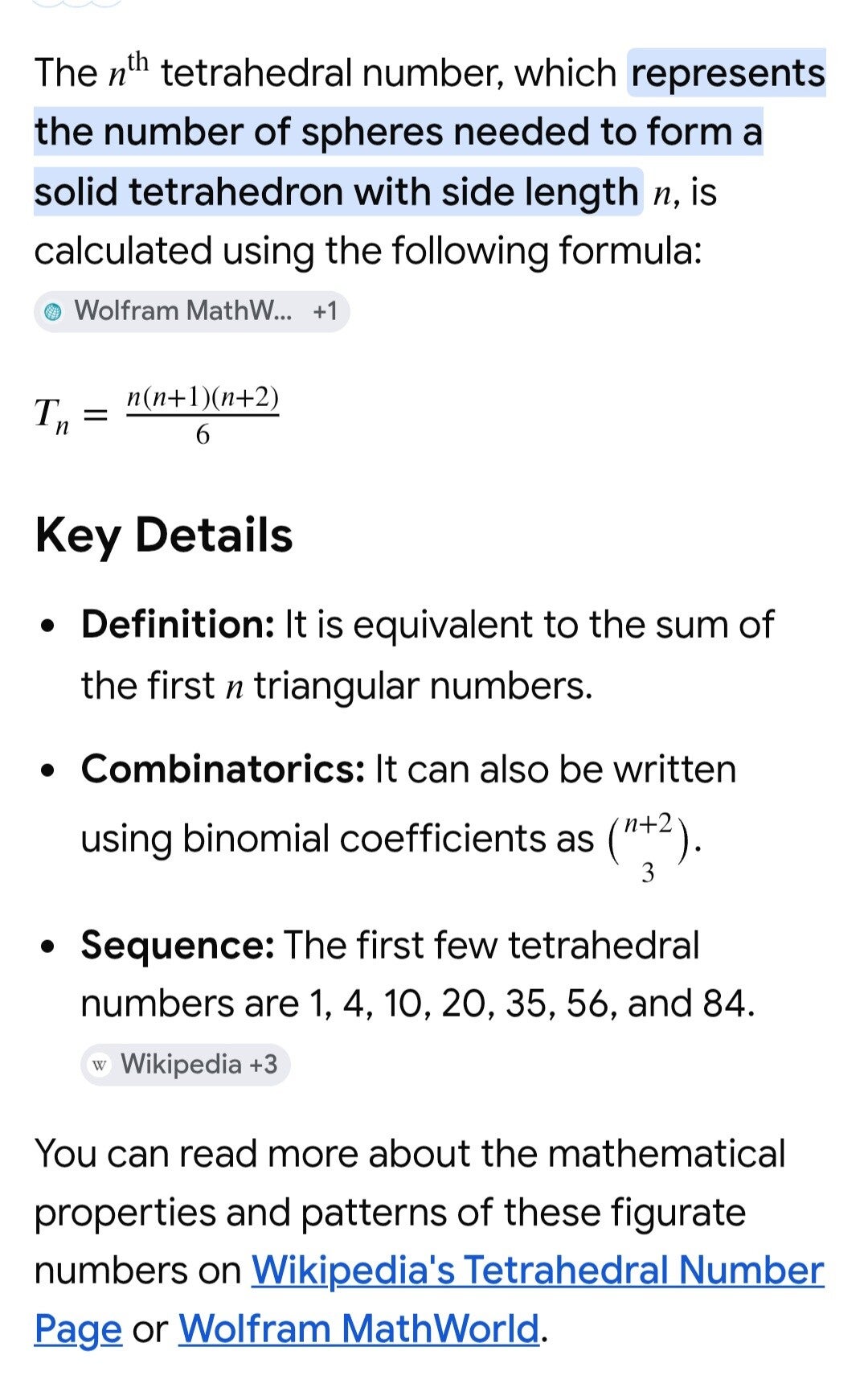
Note that with the 'n+2 choose 3' definition of the nth tetrahedral number n, we can think of 'n¹ + 2 choose 3', where n¹ = n^1 = n. This involves the Brick's Numbers.

TTDOC And Pascal's Triangle
Li
Beyond The Ordinary
The connection between The 12 Days of Christmas and Pascal’s Triangle lies in the diagonals of the triangle, which reveal the number of gifts received. Specifically, the song’s structure follows a pattern of triangular and tetrahedral numbers.
The Hidden Patterns.
Daily Gifts (Triangular Numbers):
On any given day n, the total number of items you receive is the sum of the first n integers (e.g., on Day 3, you get 3 + 2 + 1 = 6 gifts). These values—1, 3, 6, 10, 15, and so on—make up the third diagonal of Pascal’s Triangle.
Total Accumulated Gifts (Tetrahedral Numbers):
The grand total of all gifts received from Day 1 through Day 12 is found on the fourth diagonal. By Day 12, the total number of gifts is 364 (the 12th tetrahedral number), which is curiously one gift for every day of the year except Christmas itself.
The 'Hockey Stick' Rule.
This connection is a perfect example of the Hockey Stick Identity in Pascal's Triangle. This rule states that the sum of a sequence of numbers starting from the edge along a diagonal is equal to the number located one row down and in the opposite direction.
Example: To find the total gifts for 12 days, you sum the first 12 triangular numbers. On the triangle, this looks like a "hockey stick" that ends at the value 364.

TTDOC And The Sierpinski Triangle
The Sierpinski triangle and "The 12 Days of Christmas" are mathematically connected through Pascal’s Triangle. While the song relies on triangular and tetrahedral numbers found in Pascal's rows and diagonals, the Sierpinski triangle fractal emerges visually when you colour those same numbers based on their divisibility.
1st Discourse
The Sierpinski Triangle and the "12 Days of Christmas" are linked through fractal geometry, triangular numbers, and Pascal’s triangle, often brought together in festive "fractal Christmas tree" construction projects. The core connection is that the total number of gifts given in the song represents a 3D pyramid (tetrahedron) structure, which is a 3D version of the 2D Sierpinski Triangle.
Here is a breakdown of the connections:
1. The Mathematical Link: Pascal’s Triangle
If you construct Pascal’s Triangle and color all the odd numbers, the resulting pattern is the Sierpinski Triangle.
The "12 Days of Christmas" is a cumulative song. The gifts given on each day correspond to the triangular numbers (1, 3, 6, 10...). The total number of gifts given over the 12 days (364) is the 12th tetrahedral number (the sum of the first 12 triangular numbers).
This tetrahedral sum can be visualized as a 3D pyramid, which is constructed using the same fractal rules as the Sierpinski Triangle (taking a large shape and replacing it with smaller versions of itself).
2. The Practical Link: "Sierpinski Christmas Trees"
Math enthusiasts and educators often use the festive season to build physical models of 3D Sierpinski Tetrahedrons, commonly called "Sierpinski Christmas Trees."
Construction: They are built using 16, 64, or 256 smaller paper tetrahedrons to create one large, complex 3D fractal structure.
Visual Representation: This hands-on activity demonstrates how a simple recursive rule (4 tetrahedrons make a bigger tetrahedron) leads to an intricate, self-similar shape, just as a simple song formula leads to a massive total of 364 gifts.
3. Total Gifts Calculation (12 Days)
Day 1: 1 gift
Day 2: 2+1 = 3 gifts
Day 3: 3+2+1 = 6 gifts
...
Day 12: 12+11+...+1 = 78 gifts
2nd Discourse
A Sierpinski tetrahedron tree is a 3D fractal sculpture created by iteratively assembling smaller tetrahedra into larger ones, forming a triangular pyramid based on the Sierpinski triangle. It is often used as a mathematical Christmas tree, where 4 smaller tetrahedra form a larger one, and 64 or more units are combined for complex structures.
Key Aspects of the Sierpinski Tetrahedron Tree
Construction: Start by creating several small tetrahedra from paper or card. Tape three together at their edges to form a base, and add a fourth on top to create a larger "level 1" tetrahedron.
Iterative Process: To increase the size (level), take four of the previous level's tetrahedron structures and assemble them in the same configuration.
Structure:
Level 0: 1 tetrahedron.
Level 1: 4 tetrahedra.
Level 2: 16 tetrahedra.
Level 3: 64 tetrahedra, and so on.
Appearance: The final structure is a hollow, pyramid-shaped tree that can be decorated with ornaments or topped with a Von Koch snowflake.
Mathematical Properties: As a fractal, the total surface area remains constant or changes at a predictable rate, while the volume decreases with each iteration, notes Wikipedia.
These trees can be constructed in roughly 1.5 hours and are popular in STEM activities to teach geometry and fractals,

Beyond The Ordinary
As stated elsewhere (this is another example of my Applied Taugtology), STEM stands for Science, Technology, Engineering, and Mathematics. It is an interdisciplinary, pedagogical approach aimed at fostering critical thinking, innovation, and technological literacy by integrating these four fields to solve complex real-world problems.
Key Details About STEM.
Origin:
The acronym was introduced by the US National Science Foundation in 2001, replacing the earlier term SMET.
Purpose:
It aims to improve technological literacy and prepare students for the future workforce, as STEM-related careers are growing faster than non-STEM roles.
Key Fields:
Science: Biology, Chemistry, Physics, Environmental Science.
Technology:
Computer Science, IT, Electronics.
Engineering:
Civil, Mechanical, Aerospace, Electrical.
Mathematics:
Statistics, Applied Math, Pure Math.
Variations:
Often expanded to STEAM [(adding Arts) can be said to be equal to Q/Qu] STEMM (adding Medicine) to include broader skill sets.
STEM education is heavily supported by government initiatives (such as in the UK and Australia) to boost innovation and economic productivity,

Σ Pathematics Of 12 & TTDOC
In this summary, we note some of the striking ways that Q1 & Q2 are related by Synchronicity using TTDOC.
Beyond the ordinary
By taking 12 days of Christmas, the following observations are true:
🔹️ The number of presents given
on a particular day n is a
triangular number.
🔹️ The total number of presents
given after n days is a tetrahedral
number.
The total number of presents given after the full 12 days is 364; the number of (whole) days in one year minus 1 i.e. Tn with n = 12 is 364 = OBOE 365. From this it follows that: The total number of presents given over the 12 days of Christmas is equal to the number of times the Earth spins on it's axis in one year (-1).
We could introduce here a system of adjustment similar to the one for dealing with the fact that there are, in fact, 365.25 days in a year; not 365. Such a leap system for the Xmas year might involve a number of Leaping Lords (and their Ladies).
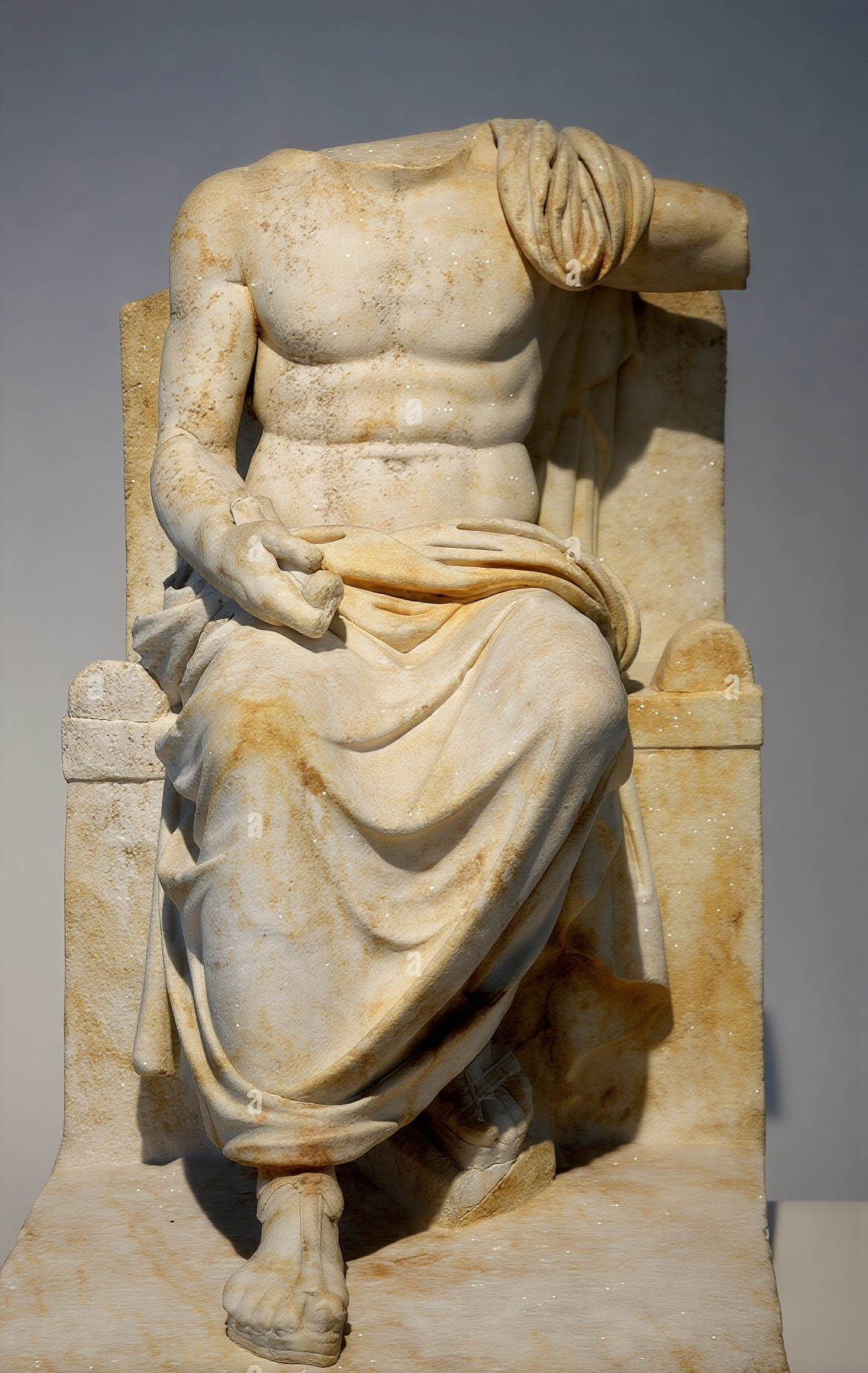
Theos Hypsistos (The Most High God). A Head God Without A Head.
Our Mistory.