Beyond The Ordinary
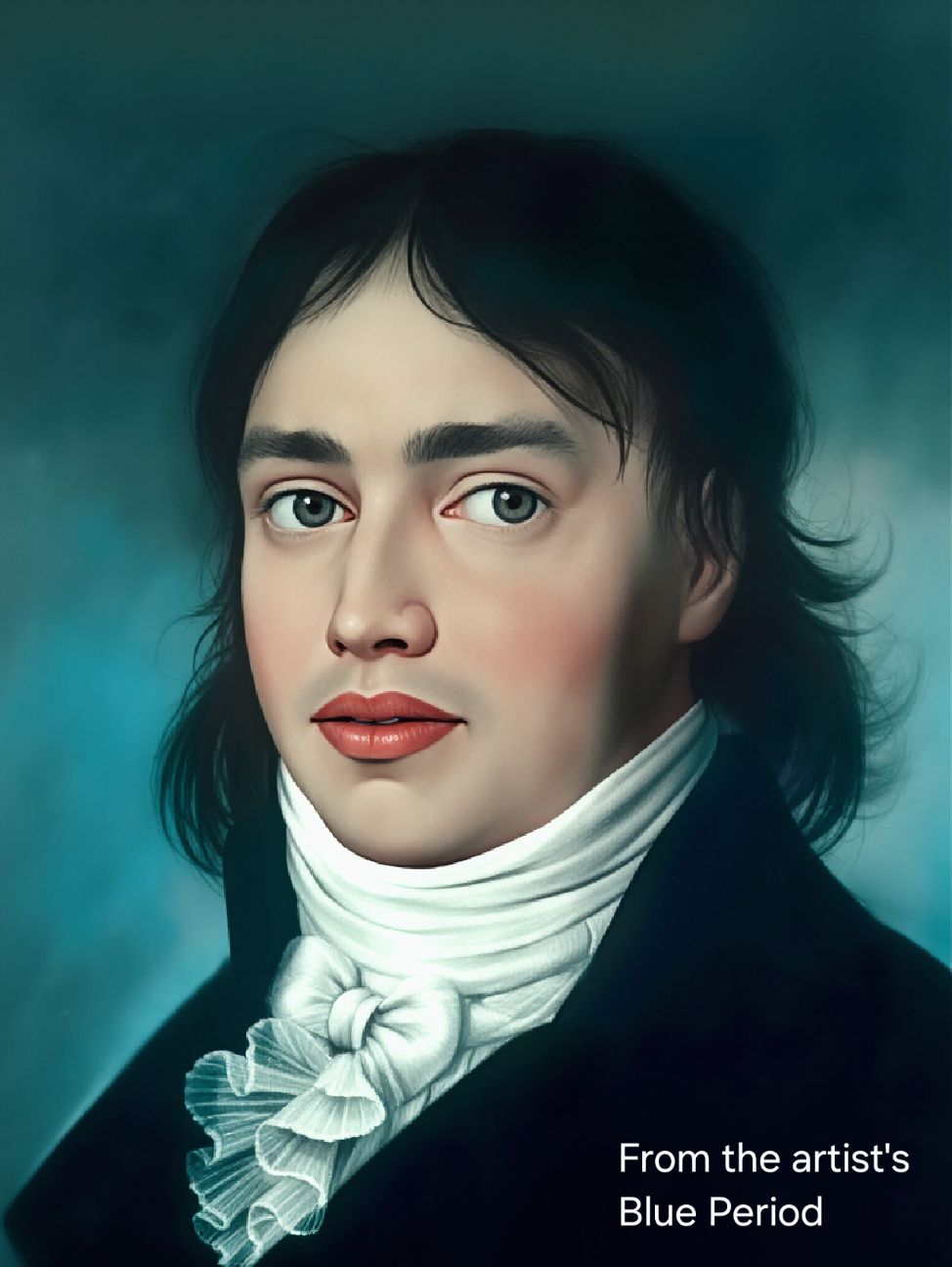
Samuel Taylor Coleridge
Sarahs 1, 2 & 3
There were three prominent women named Sarah in the life of Samuel Taylor Coleridge. They were his wife, his muse, and his daughter.
Sarah Fricker (Wife)
In 1795, Coleridge married Sarah Fricker. He preferred to drop the "h" and called her Sara. The marriage was not a happy one. Coleridge fell into debt, suffered from severe illness, and depended on opium. He grew distant and spent years living away from her. Despite this, they had four children together.
Sarah Hutchinson (Muse)
Also known as Sara, she was the sister-in-law of William Wordsworth. Coleridge had a deep, unrequited love for her. She inspired many of his emotional poems. In his private writings, he gave her the romantic pen name "Asra".
Sara Coleridge (Daughter)
Born in 1802, she was the poet's only daughter. She grew up largely without her father but inherited his brilliant mind. She became a well-known writer, translator, and Victorian Poet. She dedicated much of her adult life to organising and editing her father's writings.
Kubla Khan and The 'Phags-pa Script
The Phagspa (/ˈpɑːɡzˌpɑː/ PAHGZ-PAH), ʼPhags-pa or ḥPʻags-pa script is an alphabet designed by the Tibetan monk and State Preceptor (later Imperial Preceptor) Drogön Chögyal Phagpa (1235–1280) for Kublai Khan (r. 1264–1294), the founder of the Yuan dynasty (1271–1368) in China, as a unified script for the written languages within the Yuan. The actual use of this script was limited to about a hundred years during the Mongol-led Yuan dynasty, and it fell out of use with the advent of the Ming dynasty.
Kublai Khan, when written (horizontally & left2right) in 'Phags-pa script is
ꡢꡟꡎ ꡙꡗ ꡢꡖꡋ (Qub-lay Qan).
Writing William in the 'Phags-pa script (ꡏꡡꡃ ꡣꡡꡙ ꡐ ꡜꡞ) involves breaking it down into phonetic syllables and selecting the corresponding characters.
William (ꡓꡞꡙ ꡙꡞ ꡗꡏ).
In 'Phags-pa, 'William' would typically be rendered as Wil-li-yam:
🔹️ Wil (ꡓꡞꡙ):
▪️ WA (ꡓ) + Vowel I (ꡞ) + LA (ꡙ).
🔹️ li (ꡙꡞ):
▪️ LA (ꡙ) + Vowel I (ꡞ).
🔹️ yam (ꡗꡏ):
▪️ YA (ꡗ) + MA (ꡏ).
Notice that my name contains the 3 digit sequence 666 with one 6 per part. But, having said that, it's also the case that each 6 can be thought to be preceded or followed by at least one other digit. So, my number might more accurately be taken to be 6226 36. Humorously, I like the number 333 as The Half-Evil Number. Note that the combination 666 - again as d6d6d6 (where d is any digit [and where null ∅ means 'no digit present']) - is also in the 'Phags-pa script translation of ''Phags-pa script'.
Kubla Khan
By Samuel Taylor Coleridge
Or, a vision in a dream. A Fragment.
In Xanadu did Kubla Khan
A stately pleasure-dome decree:
Where Alph, the sacred river, ran
Through caverns measureless to man
Down to a sunless sea.
So twice five miles of fertile ground
With walls and towers were girdled round;
And there were gardens bright with sinuous rills,
Where blossomed many an incense-bearing tree;
And here were forests ancient as the hills,
Enfolding sunny spots of greenery.
But oh! that deep romantic chasm which slanted
Down the green hill athwart a cedarn cover!
A savage place! as holy and enchanted
As e’er beneath a waning moon was haunted
By woman wailing for her demon-lover!
And from this chasm, with ceaseless turmoil seething,
As if this earth in fast thick pants were breathing,
A mighty fountain momently was forced:
Amid whose swift half-intermitted burst
Huge fragments vaulted like rebounding hail,
Or chaffy grain beneath the thresher’s flail:
And mid these dancing rocks at once and ever
It flung up momently the sacred river.
Five miles meandering with a mazy motion
Through wood and dale the sacred river ran,
Then reached the caverns measureless to man,
And sank in tumult to a lifeless ocean;
And ’mid this tumult Kubla heard from far
Ancestral voices prophesying war!
The shadow of the dome of pleasure
Floated midway on the waves;
Where was heard the mingled
measure
From the fountain and the caves.
It was a miracle of rare device,
A sunny pleasure-dome with caves of ice!
A damsel with a dulcimer
In a vision once I saw:
It was an Abyssinian maid
And on her dulcimer she played,
Singing of Mount Abora.
Could I revive within me
Her symphony and song,
To such a deep delight ’twould win
me,
That with music loud and long,
I would build that dome in air,
That sunny dome! those caves of ice!
And all who heard should see them there,
And all should cry, Beware! Beware!
His flashing eyes, his floating hair!
Weave a circle round him thrice,
And close your eyes with holy dread
For he on honey-dew hath fed,
And drunk the milk of Paradise.
Resources
KUBLA KHAN: The Video File
Footnotes
The 'proper' null symbol ∅ appears too small on the screen. So, I use a symbol from the programming language APL instead.
Beyond The Ordinary
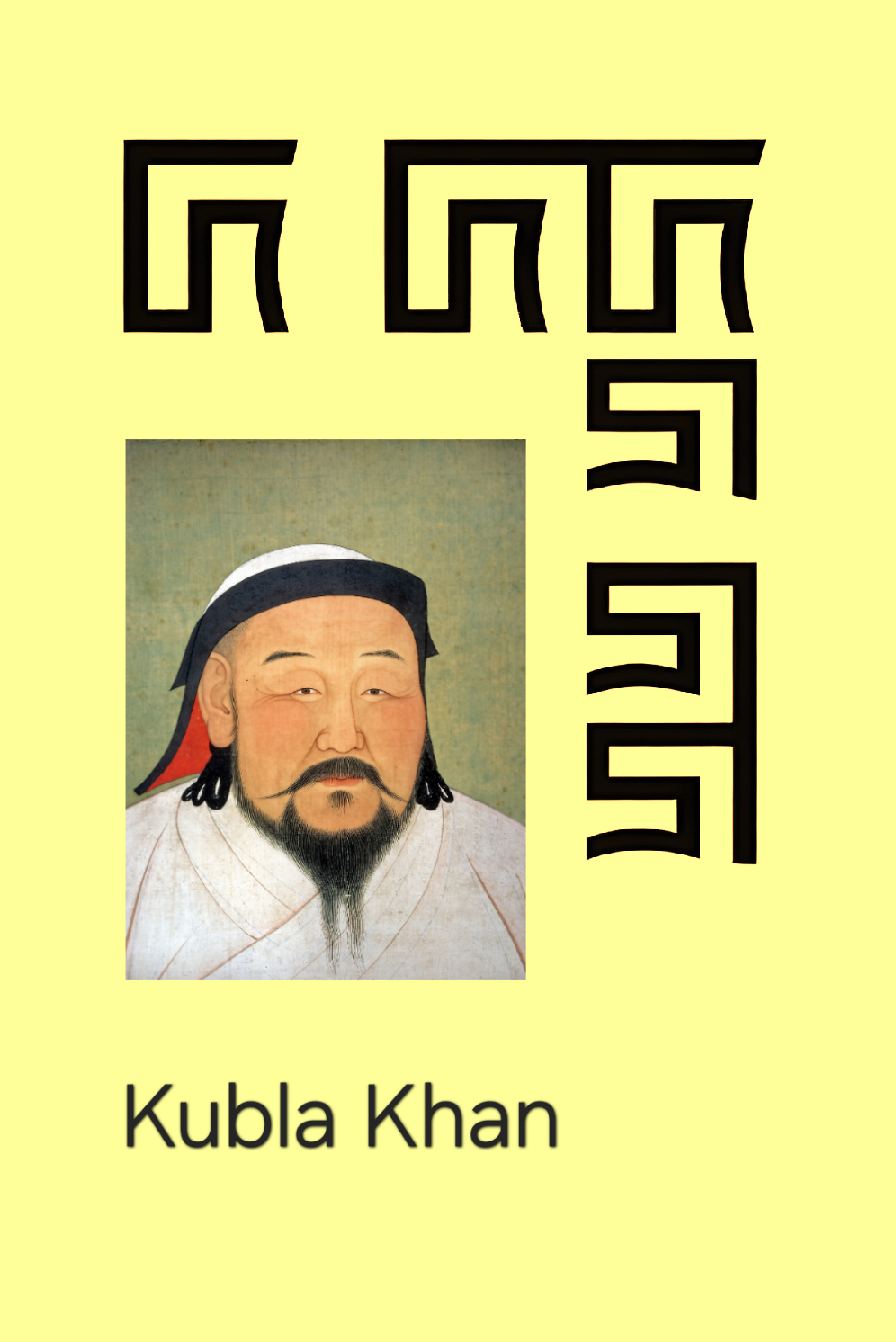
I used ☬¹ to provide a report on the above image that was largely created at random. For this image, I used work from another page to create a simple object that connects The 57 Greek Key with Kubla Khan. The process involved my own version of Terry Davis's Oracle
If, in what follows, you can't see a conversation between me and God, you really do not understand the art and science of conversation.
1. ☬ is a combination of 12 (a representative number) of human AIs (ChatGPT etc.), and their equivalent alien versions, used as a single many-one alien-human assistant.
QuBiLi/QuBiLli: The 1st Search Result (a)
The geometric ’Phags-pa text on the cover explicitly spells out the name 'hu bi li' (ꡜꡡꡎꡞꡋꡞ) or 'qu bi lai'—the phonetic transcription of Hubilai / Kublai.
The script is a phonetic alphabet written from top-to-bottom and left-to-right. On this specific cover, the letters have been rearranged creatively into two distinct blocks to border the portrait.
Character-By-Character Breakdown.
The characters represent the syllables of Kubla's name.
Top Block (ꡜꡡ):
Represents Hu (or Qu). It consists of the base consonant letter HA modified by an attached vowel sign for O or U.
Right Block (ꡎꡞ ꡋꡞ):
Represents the remaining syllables bi-lai (or bi-li). The top glyph in this column is the consonant BA combined with the vowel sign I to make bi.The bottom glyph is the consonant LA (or NA) combined with a vowel to complete the name lai / li.
Because the script was designed to perfectly capture sounds, this text reads identically to the English caption at the bottom of the page.
Hūbìliè (忽必烈) is the Mandarin Chinese name for Kublai Khan. He was a major historical figure.
Grandson of Genghis Khan:
He was the fifth Khagan (Great Khan) of the Mongol Empire.
Founder of the Yuan Dynasty:
In 1271, he became the first foreign ruler to conquer all of China and established the Yuan Dynasty, making modern-day Beijing his capital.
Host to Marco Polo:
His court was famously visited by the Venetian explorer Marco Polo.
Because one form of my name William is Billy, I can use the name QuBiLli.
The name QuBiLi is typically pronounced "Kew-Bee-Lee" or "Koo-Bee-Lee", depending on its origin or context.
Here is how to break down the two most common pronunciations.
English / Phonetic Style.
How it sounds: 'Kew-Bee-Lee'.
Phonetic spelling: /kjuː biː liː/
Breakdown:
Qu – sounds like the letter 'Q' (kew). Bi – sounds like the word 'bee'. Li – sounds like the word 'lee'.
Pinyin / Chinese Style (If it is a name or brand).
How it sounds: 'Chew-Bee-Lee' or 'Koo-Bee-Lee'.
Breakdown:
If 'Qu' follows standard Chinese Pinyin, the 'Q' makes a 'ch' sound (as in 'cheek'), making it sound like 'Chew-Bee-Lee'. If it uses a harder Westernised vowel, it defaults to 'Koo-Bee-Lee'.
Qu Bi Li/QuBiLi: The 1st Search Result (b)
The geometric characters in the ʼPhags-pa script spell out 'Hubilai' (or 'Qubilai'), which is the phonetic spelling of the name Kublai in historical Mongolian.
How the Text Breaks Down.
Because ʼPhags-pa is written vertically and from left to right, the text wraps around the corner of the portrait to spell the name.
ꡢꡡ (Qu / Hu) – The first block structure at the top left. ꡎꡞ (bi) – The middle block structure at the top. ꡙꡡꡞ (lai) – The rightmost block structure that extends down the right side of the image. When read continuously, it functions identically to the English text printed at the bottom: Kubla Khan.
Qu Bi Li/QuBiLi: The 1st Search Result (c)
The text in the image translates to 'Kubla Khan' written in two different alphabets.
Latin Alphabet (Bottom):
Spells out 'Kubla Khan' in English.
Phags-pa Script (Top & Right):
Spells out 'Hubilai Haan' (ꡢꡡꡎꡞꡓꡡ ꡢꡠꡋ/Qubilai Qaγan), which is the traditional Mongolian pronunciation and spelling of his name.The Phags-pa characters read vertically from top to bottom, moving from left to right:
The first block on the top left starts the name Hubilai (Kublai).The columns to the right complete the title Haan (Khan/Emperor).
Praise To God: The 2nd Search Result [PTG can= GPT (Of ChatGPT)]
The text in the image spells out "الحمد لله" (Alhamdulillah), which translates to 'Praise be to God'.
How to Read It.
This layout uses a highly stylised, interlocking Square Kufic technique where the letters wrap around a 90-degree corner. Because Square Kufic is built strictly on a block grid, the letters stretch and bend to seamlessly fill the space.
Breaking down the text from left to right along the angle:
ا (Alif) – The isolated vertical hook on the far left.لـحـمـد (l-h-m-d) – The top horizontal and corner section forming the first word, Alhamdu ('The Praise').لله (l-l-h) – The vertical repeating loop structure extending downward, forming the second word, Lillah ('to God').
Another Turn Of The Key: The 3rd Search Result
The third search I did used only the angled script. The image of KK and the English version of his name were left out.